In the previous article, we introduced the InfoCiutat platform, the space that provides access to the different use cases developed as part of the Terrassa Smart Buildings project.
But what happens between the moment a sensor collects data and the moment that information appears on a screen or becomes a tool for municipal management?
The answer lies in the technological infrastructure that supports the entire project.
Much more than a network of sensors
When we think of a smart city, we often imagine sensors distributed throughout the city.
However, sensors are only a small part of the system.
For data to be useful, an infrastructure is needed that is capable of:
- Collecting information from multiple sources.
- Connecting devices distributed throughout the city.
- Integrating data from different systems.
- Ensuring data quality and security.
- Facilitating data reuse.
This combination of elements is what makes smart city management possible.
An architecture designed to connect services
The Terrassa Smart Buildings project is part of the digital city model promoted by Terrassa City Council.
This model is based on a connected city in which buildings, services and platforms share information to generate knowledge and support decision-making.
The aim is not to accumulate data, but to turn it into a useful tool for improving the management of municipal facilities and public services.
The importance of open standards
One of the major challenges of any smart city project is ensuring that different technologies and systems can work together.
For this reason, the project is based on interoperability criteria that make it possible to integrate data from multiple sources and facilitate the incorporation of new services in the future.
This approach helps avoid technological dependencies and enables the platform to evolve as new needs emerge.
A project aligned with smart city standards
Terrassa Smart Buildings is being developed in accordance with the principles established in the UNE standards promoted by AENOR in the field of smart cities.
One of the most relevant is UNE 178104, which focuses on comprehensive city management systems.
These standards promote fundamental aspects such as:
- System interoperability.
- Data integration.
- Information governance.
- Digital security.
- Sustainability of technological solutions.
The aim is to ensure that the technology remains open, scalable and ready to adapt to the city’s future needs.
Data as a tool for the city
The InfoCiutat platform is the visible part of a much broader system.
Behind every visualisation is an infrastructure capable of transforming dispersed data into useful information, enabling better-informed decision-making and improved coordination of municipal services.
This ability to transform data into knowledge is one of the foundations of the Terrassa Digital City model.
Technologies used
The InfoCiutat platform follows a layered architecture model, as defined in AENOR’s UNE 178104:2017 standard on interoperability requirements for smart city platforms. Each layer provides the platform with a set of functionalities, allowing these capabilities to remain functionally independent so that they can be easily replaced or modified without affecting the rest of the architecture.
The overall solution architecture, taking into account data collection in buildings, complies with the UNE 178108 standard, which establishes the requirements for smart buildings to be considered an IoT node in accordance with UNE 178104.
The fact that our platform complies with the standards defined by the Smart Cities Technical Standardisation Committee (CTN 178) will help ensure that its components remain open and standardised, producing a key short-term benefit: interoperability with external platforms.
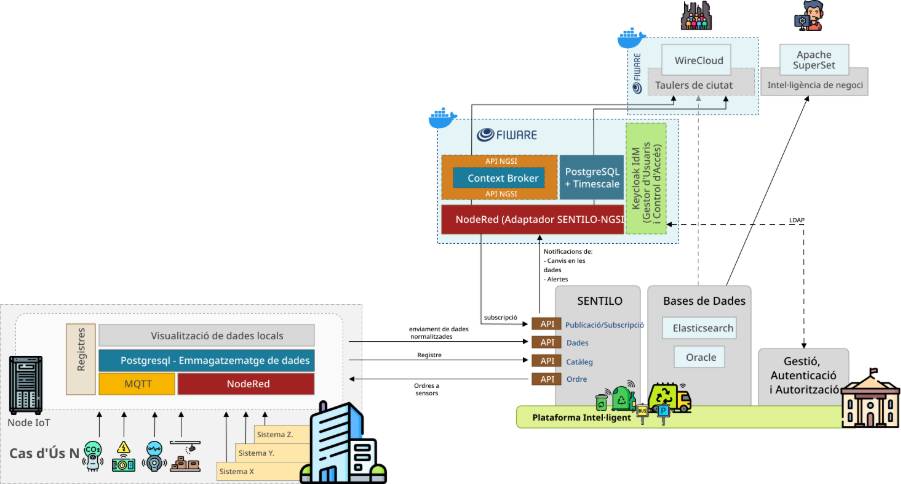
The overall architecture of the solution is shown in the following diagram:
IoT Nodes in buildings
An IoT Node has been installed in each of the buildings included in the project, in accordance with the requirements of UNE 178108, with the following characteristics:
- Ubuntu-based operating system.
- Several performance and storage options, adaptable to the characteristics of each building:
- x86
- 4 GB RAM
- 60 GB SSD
- Ability to operate using passive cooling, without fans requiring periodic maintenance.
- Flexible installation options: electrical panels, desktop or wall-mounted.
- Ethernet connectivity:
- WAN for connection to the building network and the Internet.
- LAN for the local device network.
- Mobile connectivity: SIM card for Internet access or as a backup connection.
- Multiple interfaces:
- 2 × RS-232
- 4 × USB 3.0
- 2 × Intel GbE LAN
- HDMI output
Integration of IoT Nodes with the SENTILO Terrassa platform
The integration of the IoT Nodes with the SENTILO Terrassa platform provides the following functionalities.
The IoT Nodes
- Register with the City Council’s SENTILO IoT platform.
- Collect data from sensors and/or systems using multiple protocols.
- Use Node-RED to transform the data and adapt it to SENTILO, as well as to generate alerts and alarms at an early stage.
- Store the data in PostgreSQL for the minimum period established as protection against service outages.
- Send the data to SENTILO.
- Receive commands from SENTILO to be executed by potential actuators.
The City Council’s SENTILO platform
- Manages the data using the available databases: PostgreSQL, Oracle and Elasticsearch.
Once the data has been generated by the sensors and collected by each of the IoT Nodes, it reaches the SENTILO Terrassa platform.
The project has complemented this platform with a deployment of FIWARE, turning InfoCiutat into a fully fledged smart city platform.
InfoCiutat infrastructure
The deployment of InfoCiutat is based on a containerised architecture orchestrated by a Kubernetes system.
Its main components are:
Context Broker: FIWARE Scorpio
The central component for real-time context management, enabling the integration and processing of data from multiple sources.
Scorpio manages entities and their associated data, making this information available for consumption by other services within the infrastructure.
Keycloak
This system provides authentication, authorisation and accounting (AAA) services, securely and centrally managing user access and permissions.
Keycloak enables the implementation of Single Sign-On (SSO) and Multi-Factor Authentication (MFA) to enhance platform security.
API Manager
The API Manager protects and manages access to the existing REST API by applying access policies, rate limiting and request authentication.
The system is integrated with Keycloak to ensure that only authenticated and authorised users can access API resources.
Node-RED
A tool for developing event-driven integration applications.
Node-RED enables the creation of customised data flows that facilitate the manipulation and transformation of data between the different components of the infrastructure.
Node-RED has also been used to build the adapter between Sentilo and the NGSI service bus.
It also acts as a tool for generating alarms based on state-change events in Context Broker entities.
PostgreSQL + Timescale
A database solution optimised for handling time-series data, enabling efficient storage and fast querying of historical data.
Timescale is essential for managing the large volumes of data generated and used by the visualisation tools.
MongoDB
An open-source NoSQL document database that stores documents in BSON format, which can be retrieved through queries in JSON format.
Apache Superset
A Business Intelligence (BI) data visualisation and analytics tool that allows users to create interactive dashboards and advanced charts.
Apache Superset connects to databases to provide real-time data analysis capabilities.
WireCloud
A web development platform focused on the creation of Internet of Things (IoT) applications and hybrid portals that combine information from different sources.
It allows developers and end users to visually and flexibly integrate different data sources and web services.
It is the main visualisation component of the platform.
NGINX
A high-performance and highly efficient web server configured to serve static content, mainly building images, as well as CSS stylesheets and JavaScript files.
Additional tools
The InfoCiutat platform also includes additional tools that provide a range of complementary functionalities, including:
Apache Guacamole
A free, open-source remote access gateway that allows users to connect to, view and control the desktop of computers or servers from anywhere using only a web browser, without needing to install an application or client on their device.
Drupal
Drupal has been used to develop a content grid management system for the various display screens deployed throughout the city.


0 Comments